How Did a SaaS Platform Triple Its Growth Rate in Just 10 Months?
Userpilot, a product growth platform that helps SaaS companies create personalized in-app experiences, achieved something remarkable. After spending three years building up to 25,000 monthly organic visitors, they managed to scale to 100,000 visitors in just 10 months—effectively tripling their growth rate.
The secret behind this dramatic acceleration? A strategic shift from scattered marketing efforts to a focused programmatic SEO approach that leveraged automated content generation for glossary and comparison pages.
In early 2021, Userpilot’s marketing team was spread thin across multiple channels—webinars, Quora engagement, podcasting, and traditional blog writing. Like many early-stage SaaS companies, their strategy was “a bit of everything.” However, when a fractional VP of marketing joined the team, they identified a crucial insight: 80% of their leads were coming from blog content.
Key Insight: Userpilot discovered that focusing resources on their highest-performing channel (blog content) and scaling it systematically produced exponentially better results than spreading efforts across multiple marketing channels.
What Programmatic SEO Strategy Did Userpilot Implement?
Userpilot’s programmatic SEO strategy centered on creating two main types of automated content: glossary pages and comparison pages. They identified three primary URL patterns that would capture high-intent search traffic:
/what-is-{term}/pages targeting informational queries/what-are-{term}/pages for plural term variations/blog/{tool-a}-vs-{tool-b}/comparison pages for competitive searches
The company focused on scaling their content operations first, growing from 4 monthly blog posts to 40 posts per month. This operational efficiency became the foundation for their programmatic approach.

How Did Userpilot Execute Their Content Scaling Strategy?
The execution involved building efficient content operations that could support both traditional blog content and programmatic page generation. Here’s how their approach evolved:
| Metric | Before Strategy | After Implementation |
|---|---|---|
| Monthly blog posts | 4 articles | 40 articles |
| Traffic growth timeline | 3 years to 25K visitors | 10 months to 100K visitors |
| Total indexed pages | Limited blog content | 11,000+ indexed pages |
| Monthly organic traffic | 25,000 visitors | 100,000+ visitors |
The key to their success was implementing systematic content templates that could be efficiently populated with relevant data. Rather than creating each comparison or glossary page from scratch, they developed standardized formats that maintained quality while enabling rapid scaling.
Their content team focused on creating comprehensive, search-optimized resources that addressed specific user intents. For glossary pages, they provided detailed explanations of product management and analytics terms. For comparison pages, they offered balanced evaluations between different SaaS tools and methodologies.
Operational Excellence: Userpilot’s success came from treating content creation as a scalable system rather than a series of individual projects, allowing them to maintain quality while dramatically increasing output volume.
What Were the Key Technical Implementation Details That Enabled Success?
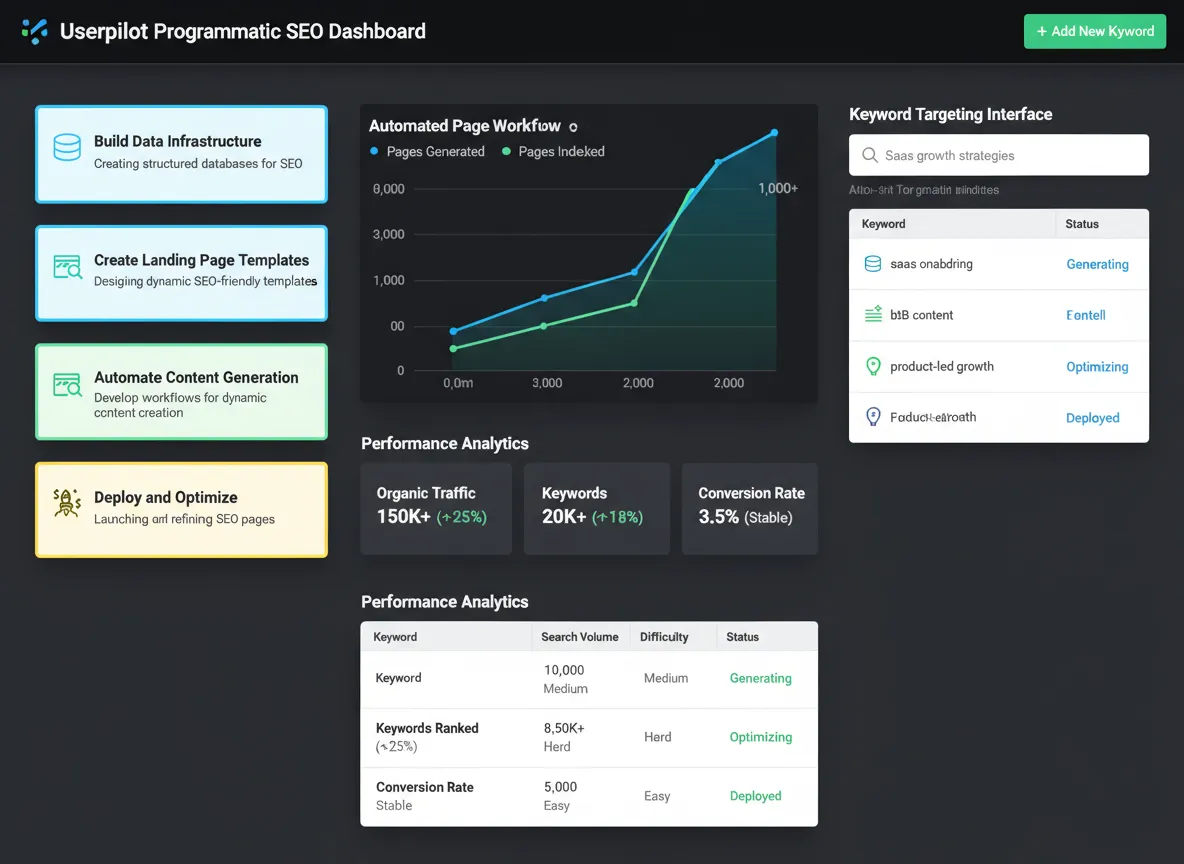
Userpilot’s technical approach focused on creating templates that could automatically generate SEO-optimized pages at scale. Their implementation included several critical components:
Template-Based Page Generation: They developed standardized page templates for both glossary and comparison content that could be populated with specific terms and data while maintaining consistent structure and optimization.
Strategic Keyword Research Targeting: The team identified high-volume, low-competition keywords in the product analytics and user engagement space, focusing on terms their target audience was actively searching for.

What Results Did Userpilot Achieve Through Programmatic SEO?
The results of Userpilot’s programmatic SEO strategy were remarkable both in scale and timeline. Within 10 months of implementing their systematic approach, they achieved:
Traffic Growth: Monthly organic visitors increased from 25,000 to over 100,000, representing a 300% growth rate that was three times faster than their previous trajectory.
Page Scale: They successfully indexed over 11,000 pages through their programmatic approach, creating a comprehensive library of educational and comparison content.
Market Positioning: By systematically covering product analytics and user engagement terminology, they established themselves as a thought leader and go-to resource in their industry.
Lead Generation Impact: With 80% of their leads originating from blog content, the dramatic increase in organic traffic directly translated to substantial business growth.
The success wasn’t just about traffic volume—the quality of visitors improved as well. By targeting specific product management and analytics terms, they attracted highly qualified prospects who were actively researching solutions in their space.
Measurable Impact: Userpilot’s programmatic SEO strategy delivered quantifiable business results, proving that systematic content scaling can accelerate growth timelines when executed with proper strategy and operational discipline.
How Can You Apply Userpilot’s Programmatic SEO Success to Your Own Business?
Userpilot’s case study demonstrates that programmatic SEO isn’t just about automation—it’s about systematically scaling what already works. Their success came from identifying their highest-performing marketing channel (blog content) and building efficient systems to scale it exponentially.
The key lessons from their approach include focusing on operational efficiency first, then applying programmatic methods to accelerate growth. They proved that with the right strategy, companies can achieve in months what previously took years.
For SaaS companies looking to replicate this success, the framework is clear: identify your highest-converting content types, develop scalable templates and processes, target systematic keyword opportunities, and maintain quality standards throughout the scaling process.
Userpilot’s journey from 25,000 to 100,000 monthly visitors in 10 months shows that programmatic SEO, when executed strategically, can fundamentally change a company’s growth trajectory and market positioning.