
Most SaaS companies prioritize keywords by search volume. This is backwards.
High-volume keywords are usually high-competition and low-intent. You’ll spend months trying to rank for them, and even if you do, the traffic won’t convert.
The better approach: prioritize by business potential first, volume second. Target keywords where the searcher actually wants what you sell, even if fewer people search for them.
Long-tail keywords convert at 2.5x the rate of broad terms. And 92% of all keywords get 10 or fewer searches per month. Those “low volume” keywords aren’t worthless. They’re where the buyers are.
Use the matrix below to categorize every keyword before you invest resources.
The Framework
We built this matrix after watching companies waste months on content that drove traffic but zero signups. The pattern was always the same: they targeted whatever had the highest search volume.
The fix is simple. Plot keywords on two axes:
- Business Potential (Y-axis): How likely is someone searching this to buy your product?
- Search Volume (X-axis): How many people search for this monthly?
This gives you four quadrants.
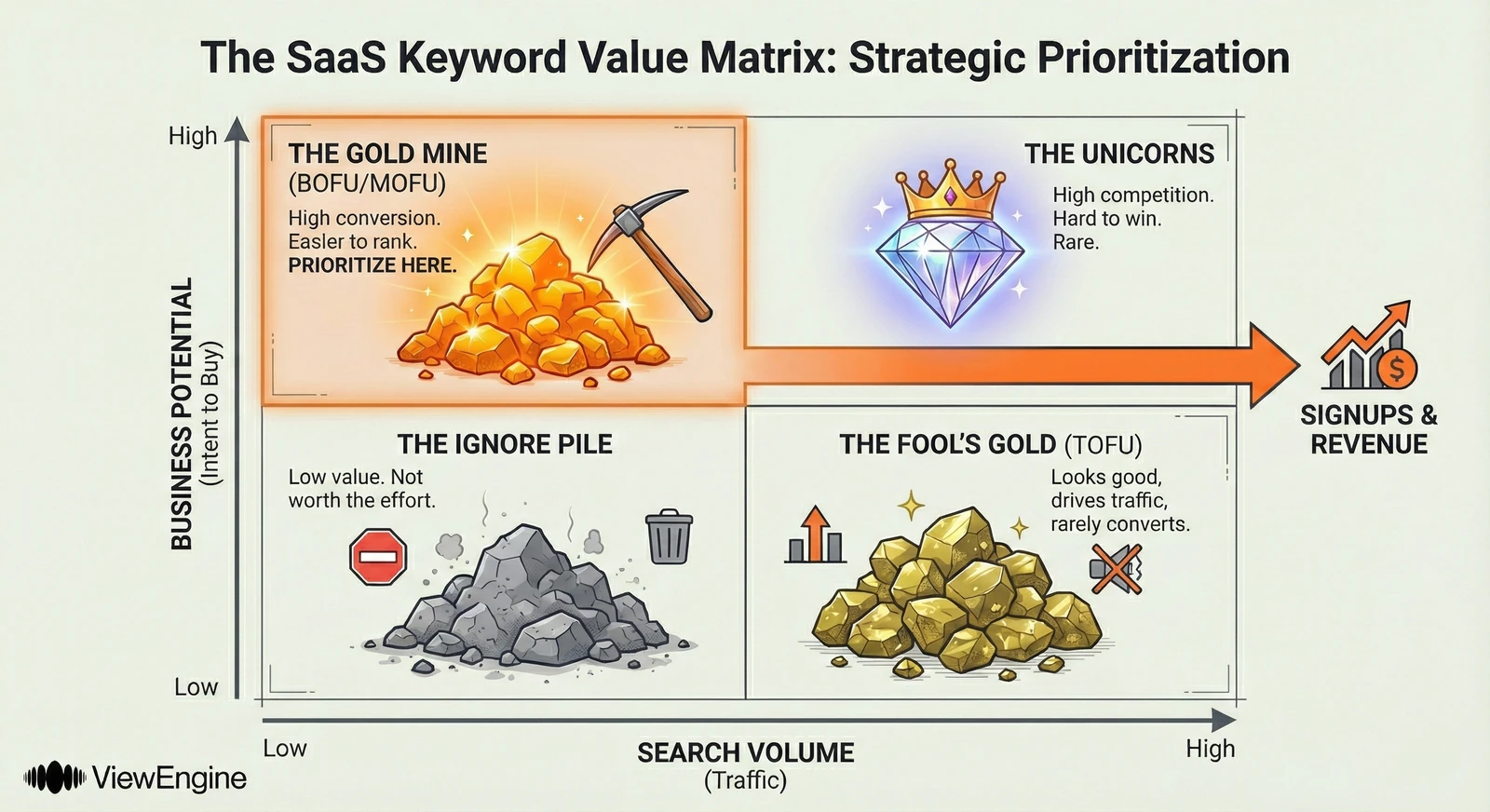
The Four Quadrants
The Gold Mine (Top-Left): High Intent, Lower Volume
This is where you start.
These keywords have strong buying intent but don’t show huge search numbers. They’re specific. They’re bottom-of-funnel or middle-of-funnel. And they’re easier to rank for because your competitors are too busy chasing volume.
Examples:
- “CRM for real estate teams”
- “project management tool with Slack integration”
- “Salesforce alternative for small teams”
The search volume might be 100-500/month. But the people searching are ready to buy. One page ranking here can outperform ten pages of high-volume content.
Prioritize these first.
The Unicorns (Top-Right): High Intent, High Volume
The dream keywords. High volume, high intent, and directly relevant to your product.
They exist, but they’re rare. And they’re brutally competitive. The top result on Google gets 27.6% of all clicks. Position 10 gets 2.5%. If you’re not in the top 3, you’re getting scraps.
Examples:
- “best CRM software”
- “project management tools”
These are worth targeting eventually, but only after you’ve built authority from Gold Mine wins. Don’t start here.
The Fool’s Gold (Bottom-Right): Low Intent, High Volume
This is the trap.
These keywords look great in your SEO tool. Thousands of monthly searches. Moderate difficulty. So you write the content, you rank, you get traffic.
Then nothing happens. No signups. No demos. Just pageviews.
The problem: these are usually top-of-funnel informational queries. The searcher isn’t looking to buy anything. They’re researching, learning, or just curious.
Examples:
- “what is CRM”
- “project management best practices”
- “how to manage a remote team”
70% of all searches are long-tail queries with specific intent. These broad TOFU keywords are the other 30%, and they rarely convert to pipeline.
Build this content later for brand awareness. Don’t prioritize it early.
The Ignore Pile (Bottom-Left): Low Intent, Low Volume
Skip these entirely.
Low search volume and no buying intent. There’s no upside. Even if you rank #1, you’ll get minimal traffic from people who don’t want your product.
Examples:
- Generic industry terms with no commercial angle
- Obscure questions unrelated to your solution
Don’t waste time here.
How to Evaluate a Keyword
Before creating content for any keyword, answer two questions:
1. What’s the business potential?
Could you naturally mention your product as a solution? Score it 0-3:
- 0 = No connection. Mentioning your product would feel forced.
- 1 = Tangential. Related topic, but you’re not the answer.
- 2 = Relevant. Your product solves part of what they need.
- 3 = Direct fit. Your product is exactly what they’re searching for.
Keywords scoring 2-3 go in the top row of the matrix. Keywords scoring 0-1 go in the bottom.
2. Can you realistically rank?
Check the actual search results, not just the difficulty score. If the top 10 is dominated by HubSpot, G2, Capterra, and enterprise players, move on. Sites ranking #1 typically have 3.8x more backlinks than lower positions.
Look for SERPs where you see smaller blogs, forums, or outdated content. That’s where you can win.
The Priority Sequence
Most companies go: high volume first, work down from there.
Flip it:
- Gold Mine keywords first. Build pipeline while you build authority.
- Unicorns second. Once you have traction, compete for the big terms.
- Fool’s Gold last. Add TOFU content for brand awareness after revenue is flowing.
- Ignore Pile never.
This approach generates signups faster. You’re not waiting 12 months to see if your “what is CRM” post eventually leads someone to a demo.
Use the Matrix
Save the infographic. Use it to evaluate your next 10 keyword targets. If most of them fall in the bottom row, you’re optimizing for vanity metrics.
The goal isn’t traffic. It’s signups.
Start with the Gold Mine.