
Table of Contents
- How Does G2 Dominate Software Discovery Through SEO?
- What Makes G2’s URL Pattern Strategy So Effective?
- How Does G2 Automate Content Creation at Scale?
- What Are the Measurable Results of G2’s Programmatic SEO?
- How Can You Implement G2’s Programmatic SEO Strategy?
- What Does This Mean for Your Business?
How Does G2 Dominate Software Discovery Through SEO?
When you’re searching for business software, there’s a high chance you’ve encountered G2’s pages ranking at the top of search results. This isn’t by accident—G2 has mastered programmatic SEO to capture millions of searchers looking for software solutions.
G2, the world’s largest software marketplace, generates over 6.6 million monthly organic visits through sophisticated programmatic SEO. By automating comparison pages, product reviews, and category listings, they’ve positioned themselves as the go-to destination for software discovery.
Key Insight: G2’s programmatic SEO generates over 2.3 million monthly organic visits, representing 92% of their total organic traffic according to traffic analysis data.
The company has created hundreds of thousands of targeted pages that capture search intent across the entire software buying journey—from initial research to final purchase decisions.
How Does G2 Automate Content Creation at Scale?
G2’s programmatic SEO success lies in their systematic approach to content optimization, transforming database information into SEO-optimized pages.
Data-Driven Template System G2 uses standardized templates pulling from their product database. Each comparison page follows consistent structure: product overviews, feature comparisons, pricing tables, and user review summaries.
User-Generated Content Integration The platform leverages 2 million+ trusted reviews from their official reports to populate pages with fresh content. User reviews provide unique text that search engines value while enhancing credibility.
Traffic Impact: G2’s systematic content automation enables ranking for thousands of software-related keywords, with organic search driving 63.71% of total website traffic.
| Page Type | Content Sources | Update Frequency | SEO Impact |
|---|---|---|---|
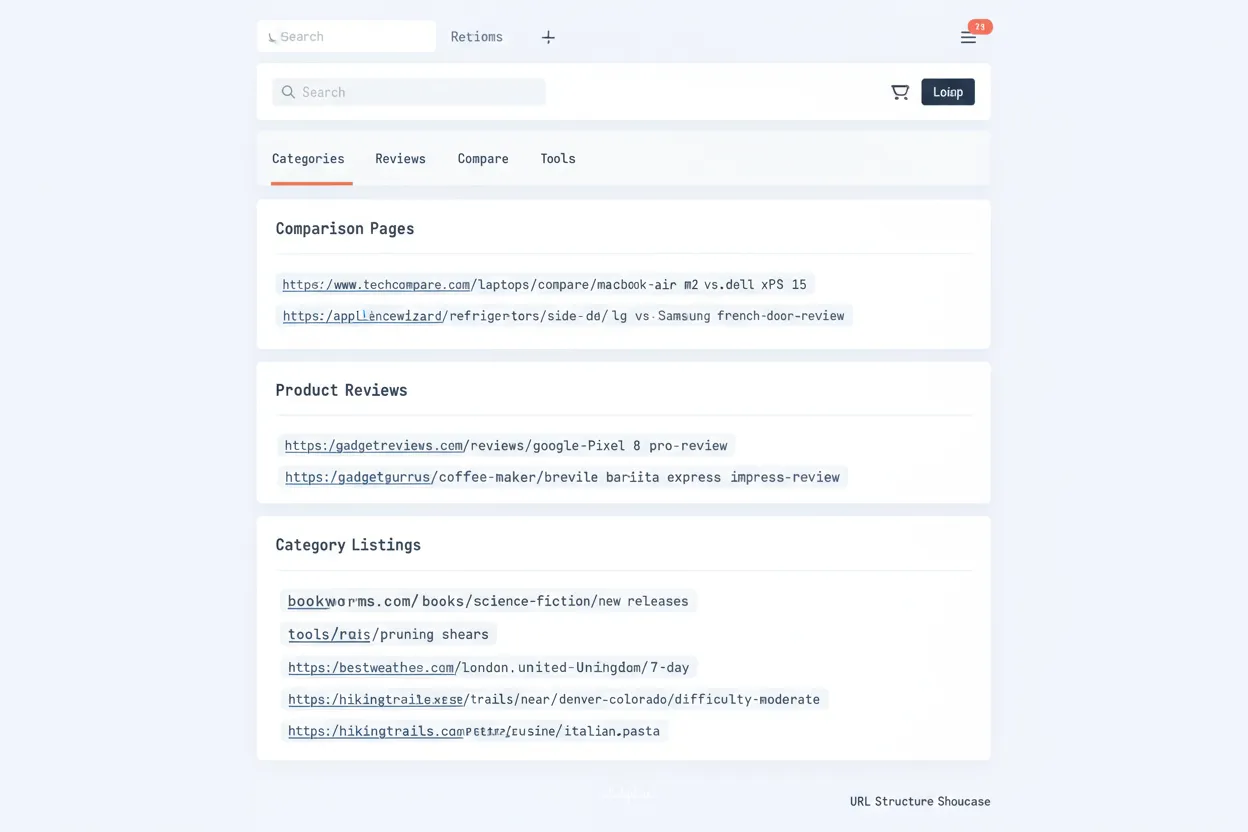
| Comparison Pages | Product specs, user reviews, pricing | Real-time | High commercial intent keywords |
| Product Reviews | User ratings, testimonials, features | Daily | Product-specific long-tail keywords |
| Category Pages | Product listings, market data | Weekly | Broad category keywords |
How Can You Implement G2’s Programmatic SEO Strategy?
G2’s approach provides a blueprint for scaling SEO through programmatic content creation:
1. Identify Your Data Assets Catalog structured data you can leverage. G2 uses product information and user reviews. Your equivalent might be inventory data, customer testimonials, or service locations.
2. Map Search Intent Patterns Analyze how your audience searches. G2 identified “X vs Y,” “[product] reviews,” and “[category] for [business size]” patterns.
3. Create Template Systems Develop standardized page templates that pull from your database while addressing specific search intent.
4. Build Content Refresh Mechanisms Implement systems to keep pages updated with fresh data, similar to G2’s real-time review integration.
Implementation Tip: Start with 50-100 programmatic pages to test your approach before scaling. Monitor ranking performance and user experience to refine templates.
What Does This Mean for Your Business?
G2’s programmatic SEO success demonstrates that systematic content creation can generate massive organic traffic when executed strategically. Their combination of structured data with user-generated content creates sustainable competitive advantage.
The key takeaway isn’t just scale—it’s systematic thinking. By identifying search intent patterns, creating scalable templates, and leveraging unique data assets, G2 built an SEO engine that grows stronger over time.
For your business, the opportunity lies in identifying your data assets and search patterns. Whether in e-commerce, services, or SaaS, programmatic SEO can help capture long-tail keywords at scale.
The results prove the concept: 6.6 million monthly organic visits and dominance in software discovery searches through strategic automation and content creation.